
Before Everything Else... Is Me.
Trauma shaped my life. But it never earned the right to become my identity.

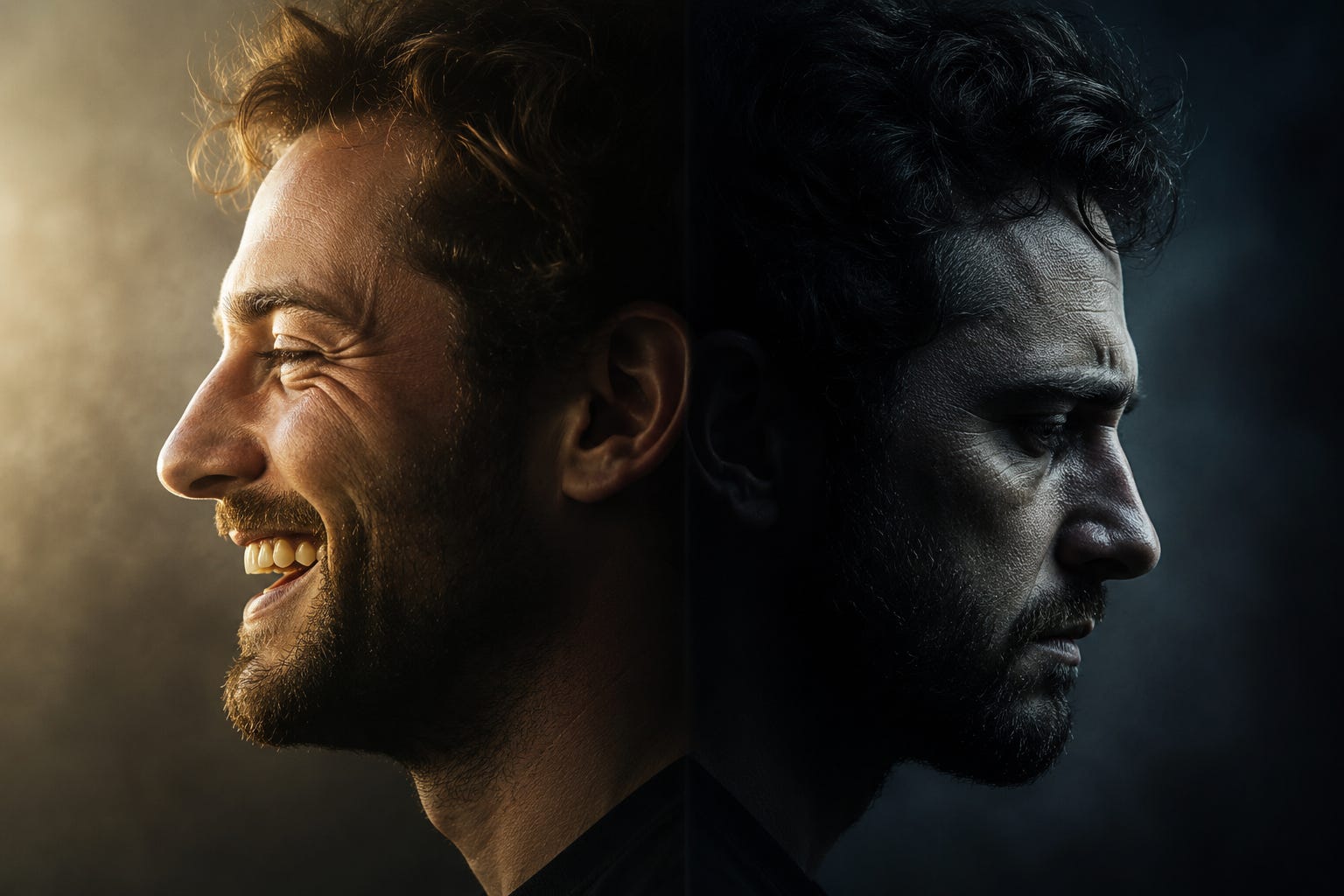
This is a long response to comments on notes rather than a pre-planned article.
About four weeks ago, someone on here sent me a message completely out of the blue.
We weren’t close. We hadn’t spent months talking. We had only crossed paths because they’d been reading my articles and leaving thoughtful comments underneath them. That was the connection.
They want to remain anonymous, so that’s exactly how it will stay.
That day they messaged me because something had happened in their own life. They felt trapped. Overwhelmed. In their words, “in a bind.”
To me, if I’m honest, it barely registered. In my head, it sat somewhere between being acknowledged and completely forgotten.
To them, it was a 10/10 situation. And in true British style, especially where I was brought up, that became the narrative.
They panicked. I turned everything into a joke.
To many people my behaviour would be considered inappropriate or wrong, and I can acknowledge that.
But that conversation reminded me of something I think we forget far too easily. We don’t all carry the same weight. The thing that barely slows one person down can completely flatten someone else.
Stress and anxiety doesn’t work to a universal scale. It never has.
So we spent the day talking. Mostly laughing. I took the piss out of them. They tried to do the same back... and failed. I’m joking... well.
But underneath all of that, they said something to me that I’ve already heard a few times before — which is becoming more of a steady thread since I joined social media four months ago.
They told me they didn’t fully believe they were talking to the same person, asking how I could possibly be the one who writes those raw and painful articles and the bloke making stupid jokes in front of them right now.
They couldn’t make the two versions fit together, as if the writer and the clown lived in different bodies.
On here, I’ve been asked similar things quite a few times now, and since starting a second account I’ve noticed it even more. There has definitely been a change in how some people see me, and that’s fine. I get it. It’s understandable.
Anyway, this person had taken such an interest in my life story, and in me personally, that I sent them Part One of my memoir.
Only a handful of people have ever been given access to it. My mum and three sisters haven’t read it, although that was their choice, I offered it to, gave them access to it and they didn’t read it. Make of that as you wish.
To my knowledge, of the people who’ve had access, no-one’s read it all, although one person is currently making their way through it.
But this person read the entire thing in two days.
Fifty thousand words.
The story of my life up until I was sixteen.
Based on that alone, they know more specific details and have a more accurate timeline than anyone else in the world. A stranger knows infinitely more than my mum or sisters ever have, or ever will.
And they came back with some of the kindest words about me I’ve ever received from anyone. They’ll remain private, but one thing they said is worth mentioning here.
They told me they’d been on Substack a long time and had never read anything like it, highlighting that the language used was completely different to everything else they’d read.
It’s really important to understand everything written from this point on is my “personal opinion”, based solely on my own experiences. It does not speak for anyone else and should not be taken as representing anyone else’s experiences. It is not an endorsement of anything, nor is it intended to belittle, judge or dismiss anyone else’s disorder, diagnosis, circumstances or life experiences.
I do use different language to many people writing about mental health, but there’s a reason for that.
Partly the era I grew up in, but mostly it’s much simpler. I use words that make sense to me. If I don’t fully understand what a term means, or it leaves too much open to interpretation, I don’t use it.
Take “neurodivergent.” I don’t use it because I don’t know what it means. Different people use it in different ways. And because it’s not an actual defined medical term I don’t know what someone is trying to communicate.
That doesn’t make it wrong, or me right. It simply means it isn’t language that works for me.
The same with “nervous system.” To me, that’s our entire central computer. If I’m talking specifically about fight, flight or freeze, I’ll call it that.
And “masking.” I understand what people are trying to describe, but I don’t use it, because, to me, everybody masks.
We all behave differently depending on where we are. We speak differently at work than we do at home. We behave differently with friends than we do in a meeting. And we all even present different versions of ourselves in these “same” different environments, so it isn’t a word I naturally use.
I choose the language that makes sense in my own head. Not because I’m right or someone else is wrong.
But after reading Part One the bigger question still hadn’t gone away.
They repeated it again.
“If that’s what you’ve lived through... how can you be like this? I’m still not entirely sure it’s the same person.”
And it’s a fair question... because what they read, for most people, wasn’t easy.
They read about a little boy with a disorder not recognised for until I was 21, ADHD, who grew up on a council estate, raised by a single mum trying to hold together five children, one of whom has a learning disability.
About a father with severe mental illness, who spent large parts of his life institutionalised and certified insane, and was never part of my life in any meaningful sense.
They read that from the age of four I refused to go inside shops, so my mum would leave me standing outside while she went in.
By six or seven she was working four nights every week, which meant large chunks of my childhood simply happened without a parent around.
That never once has my Mum said the words “I love you”. And that those words have never left my mouth either when speaking to another person (not with genuine serious intent.)
By eight I’d stopped going to bed altogether because my ADHD meant sleep barely existed. Night after night I slept on the sofa instead.
Between nine and eleven, my mum’s partner — who also happened to be the deputy headteacher at my school — abused me sexually, physically and emotionally.
At ten, the object that made me feel safest enough to sleep wasn’t a teddy bear.
It was a bread knife.
At thirteen I started smoking cannabis.
At fourteen I developed an anxiety disorder.
At fifteen the panic attacks arrived properly. Classrooms became impossible. Assembly halls. Cinemas. Theatres. Buses. Trains. Planes. Anywhere I couldn’t simply walk out stopped feeling safe. So I stopped going in them.
It was over 23 years later that I even went back into a cinema.
That same year came my first major breakdown and a drug-induced psychosis.
At sixteen I was prescribed Seroxat, a drug that would later become the centre of legal action because of what it did to so many young people.
During that same year I found myself trying to stop my biological father from kidnapping my disabled brother. He knocked me out stone cold unconscious.
Then came my GCSEs, another complete collapse, shingles that left doctors scratching their heads because children aren’t supposed to get shingles, six weeks of a summer holiday that disappeared while my body simply shut down, depression settling in, and agoraphobia beginning to tighten its grip.
That’s where my life story ended to them.
At sixteen.
It’s a bleak read.
There’s no point pretending otherwise.
If someone only knew me through those pages, they’d probably picture someone permanently broken. Someone who sits quietly in dark rooms thinking dark thoughts. Someone whose entire personality has become their trauma.
I understand why.
But they’d also be very wrong.
This might sound crazy to some people, but when I look back on my childhood, I mostly remember it with real fondness.
Yes, there was a period when I was frightened a lot, but that was because of the physical abuse. The other side of it, I didn’t understand at the time, so it wasn’t something I consciously carried around with me.
But it was also only a small part of my childhood - not all of it.
What I do remember is having fun. I was always outside. Bikes. Parks. Climbing hills. Sledging in the winter. Running around until it got dark. I absolutely loved it.
In many ways, I don’t fit the ADHD narrative people often expect. I loved school. Did I hate sitting still through lessons? Yes, of course. Waiting around drove me mad. But most things about school, I loved.
In fact, where many people with ADHD describe secondary school as one of the worst periods of their lives, the first few years were the best years of mine.
If I could go back and do them all again tomorrow, I would.
The anxiety years weren’t easy at all. They were fucking rough. Really horrific.
Panic attacks crippled me. And yes, I cried a lot. And yes, I felt at times like I was getting the shit beaten out of me.
But these were different times.
I wasn’t writing articles about it on Substack.
Posting about it on Instagram.
Or part of a Facebook support group.
It wasn’t, and could never have been, a topic of conversation with friends. Or anyone else, for that matter.
So, while it occupied a huge part of my internal world, it barely existed in my external one.
So while every single one of those things was happening...
I was laughing. Constantly.
I loved my mates.
I loved football.
I loved winding teachers up.
I loved seeing people laugh.
I was forever messing about, forever finding the ridiculous in almost everything. I could spend an entire day being an absolute idiot, then go home and fight battles that no-one knew existed.
People today often call that masking.
Maybe parts were.
But truthfully, I don’t think so. It certainly wasn’t something I consciously did. Yes, I hid what I needed to, but that was because society told me I had to do that. It wasn’t something that was up for debate.
But the person underneath everything was me. The personality was me.
And it still is.
The world has always felt unbearably heavy to me. Maybe that’s exactly why I’ve spent my entire life trying to make it lighter.
I don’t enjoy taking life seriously all the time. I never have.
Forget about me for a moment. Life is hard for most people. Sometimes it’s unbelievably hard. It can be cruel. It will throw things at you that you never saw coming, at times you never expected, and leave you hurting in ways you never imagined possible.
None of us gets through life untouched.
That’s exactly why I’ve never understood the idea that every waking moment has to be spent staring into the darkness. If life insists on giving us enough pain whether we ask for it or not, then I’ll take every opportunity I can to laugh, to be childish, to be ridiculous, and to find something that makes it feel just a little lighter.
Not because I don’t understand suffering.
Because I do.
And I can say with absolute certainty that if I hadn’t lived the life I have, I’d be even more of a clown than the person here today.
I’ve always preferred humour. Stupid conversations. Pointless jokes.
Finding something ridiculous in situations and refusing to let misery win... because the misery is already there. I can’t hide from it.
But I can say “Fuck you” to it and laugh anyway.
That’s not because I don’t understand darkness.
I know it intimately.
For years I wrestled with something I couldn’t properly explain.
Who was I? Was I the frightened boy carrying a knife to bed? Was I the teenager whose world was shrinking because panic dictated where he could go? Was I the abused child? The depressed one? The anxious one?
Or was I the idiot laughing until his stomach hurt because one of his mates had said something completely ridiculous?
The answer took me a very long time to find.
They’re all me.
But they are not all of me.
There’s an enormous difference.
Pain can shape your life. It can influence your decisions. It can leave scars that never truly disappear. But it doesn’t automatically become your entire identity unless you allow it to.
Of course everything has changed me. And I’d be lying to say that it hasn’t shaped large parts of my identity. How could it not?
But it didn’t become all of me - it’s not my entire identity.
For years I came dangerously close to becoming someone who was defined entirely by what had happened to me instead of who I actually am.
That’s a fight I still have today. Not against my past. Against letting my past introduce me before I have the chance to introduce myself.
So when someone asks how the man writing these articles can also spend hours acting like a complete fool...
The answer is simple.
Because I came first.
I was there before the abuse.
Before the diagnoses.
Before the panic attacks.
Before the breakdowns.
Before the drugs.
Life buried me under an awful lot of rubble. Sometimes it buried me so deeply I wondered whether I was still there at all.
But I never disappeared. I’m still the real one standing here today. The rest is simply the story of everything that tried to convince me otherwise.
Darkness occupied enough of my life already.
It has taken almost every single thing from me. But I never allowed it to own “all” of me.
There is a big difference between owning my life and owning my personality.
And I will never allow one person to own me.
I will not allow moments to own me.
I will not allow a diagnosis to own me.
And I will not allow one chapter of my life to define the whole story.
Because… I define me.
Never someone else.
And never a disorder.
Me.
I. Define. Me.
"In the midst of winter, I found there was, within me, an invincible summer."--Albert Camus
Thank you for trusting me to share this with my students, I did this today, they were moved by your experience but also how you write about it. They wanted to say thank you in this very small way.
Four group student reflections from (Southern Cross Education Institution):
The story is so well written, I feel like I am there with him, I am moved by his explanations of his experience. We did not realize it holds so much pain. It keeps the reader interested and eager to know more. So sorry for the experience. Thank you for sharing it with us.
Your story inspires us and everyone reading it today, that negative impact or trauma does not stop your life. You have realised you need to keep going by accepting the challenges to make reclaim your identity. We are so grateful to read it and discuss in class.
Your experiences and reflections meant a lot to us and to understand intersectionality in masculinity. Its eye opening, how living in the same society, we go through different yet similar experiences in life. We feel the need to question ourselves, our worth, our capability based on what others think or say about us, feel like being cornered into feeling like there is no one therefore for us. Some people try to give up on themselves; some learn from the experience and change their whole perspective of the world and improve and adapt. I hope you are doing well now. I hope you know you are worth it there is nothing wrong with you. I hope we call all make a difference in our society so that later generations wouldn't be questioning themselves and men in particular can express themselves well rather than suppressing everything, feeling afraid of being judged, this is so lonely and isolating. We (men) need to talk about this and challenge dominent society.
Your story is very inspiring and moved us, it's so well written. I know, that the society we live in men experiment alot of pressure and expect to be strong and confident, which means men should not cry, hide their emotions and cannot go through mental health problems. But you fight against that all, you overcame your trauma and you didn't let your identity be defined by others. I admire your bravery and grateful for a males view.